



Is your Windows 11 or Windows 10 PC feeling slow even though you don’t have many applications running? Before restarting your computer, one troubleshooting step you can try is checking how much memory Windows has cached and, when necessary, clearing the standby memory.
Microsoft offers a free utility called RAMMap that lets you see exactly how Windows is using physical memory. It also includes an option called Empty Standby List, which can clear standby memory with a single click.
In this guide, we’ll show you how to check cached RAM in Windows 11 and Windows 10 and clear it safely using Microsoft RAMMap.
Quick Answer: To clear cached RAM in Windows, download Microsoft RAMMap, run it as administrator, click Empty in the menu bar, and select Empty Standby List. Windows will release the standby memory, and you can verify the change in Task Manager.
What Is Cached RAM in Windows?
Windows doesn’t necessarily leave unused RAM completely empty.
Instead, it can use available memory to cache frequently accessed data. This helps Windows and applications access data faster when it is needed again.
You can see this memory in:
Task Manager > Performance > Memory > Cached
Seeing several gigabytes of cached memory is therefore not automatically a problem.
Windows normally manages this memory itself and can reclaim cached or standby memory when applications need additional RAM.
However, manually clearing standby memory can be useful as a troubleshooting step when you’re investigating unusual memory usage, low available memory, or a PC that feels sluggish despite having relatively few applications open.
How to Check Cached RAM in Windows 11 or Windows 10
Before clearing anything, check how much memory is currently cached.
Right-click the Taskbar and select Task Manager.
Once Task Manager opens, select Performance from the left sidebar and then click Memory.
Look toward the bottom of the Memory page. Windows displays several memory statistics, including:
- In use
- Available
- Committed
- Cached
- Paged pool
- Non-paged pool
Pay attention to the Cached value.
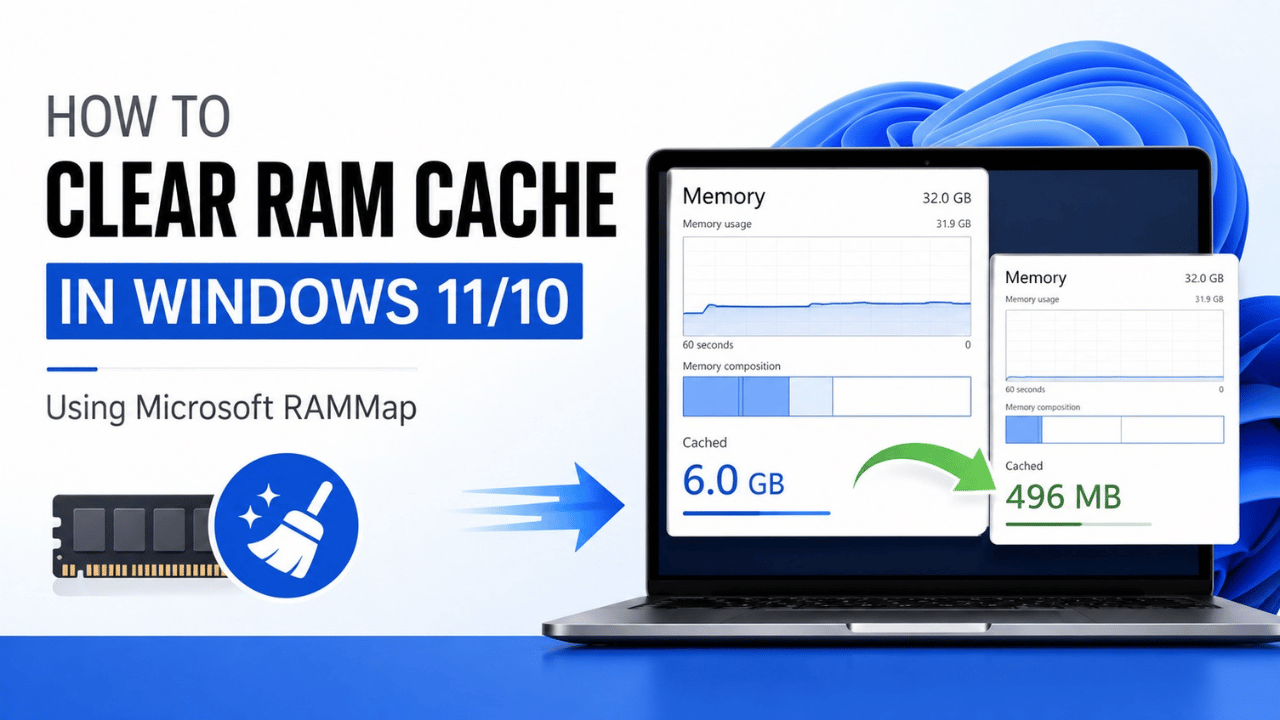
For example, on our test PC with 32 GB of RAM, Task Manager showed approximately 6 GB of cached memory before we used RAMMap.
Your result could be considerably different depending on your RAM capacity, applications, uptime, and how you’ve been using the PC.
How to Clear RAM Cache in Windows Using Microsoft RAMMap
Microsoft RAMMap is part of the Sysinternals utilities and provides a much more detailed look at how Windows is allocating physical memory.
Here’s how to use it.
1. Download Microsoft RAMMap
Open your web browser and visit the official Microsoft Sysinternals RAMMap page.
Look for Download RAMMap and click it.
The utility is a small download and arrives as a ZIP archive.
Important: We recommend downloading RAMMap directly from Microsoft rather than third-party download websites.
2. Extract RAMMap
Open your Downloads folder and locate the downloaded RAMMap ZIP file.
Right-click the file and select:
Extract All > Extract
Open the extracted folder when the process finishes.
3. Run RAMMap
Inside the extracted folder, locate RAMMap.exe and Double-click it.
If Windows displays a User Account Control (UAC) prompt, click Yes.
Follow the on-screen instructions and accept the license agreement to launch RAMMap.
You’ll now see a detailed breakdown of how physical memory is being used on your Windows PC.
4. Empty the Standby List
This is the important part.
Keep Task Manager > Performance > Memory open alongside RAMMap if you want to see the change happen in real time.
In RAMMap, click Empty > Empty Standby List
That’s it.
RAMMap will clear the standby memory, and you should see the Cached value in Task Manager decrease.
In our test, cached memory dropped from approximately:
6 GB → 496 MB
The exact amount will vary from one PC to another.
Does Clearing Cached RAM Make Windows Faster?
Not necessarily.
This is an important distinction because cached RAM itself isn’t inherently bad.
Windows intentionally uses otherwise available memory for caching because keeping useful data in RAM can be faster than retrieving it again from storage.
Windows can normally reclaim standby memory automatically when another application requires it.
So you shouldn’t treat a high Cached number in Task Manager as something that always needs to be cleared.
Instead, RAMMap’s Empty Standby List option is better viewed as a troubleshooting tool.
It may be worth trying when:
- Windows feels unusually sluggish.
- You’re troubleshooting abnormal memory usage.
- Available RAM is unexpectedly low.
- An application or game appears to have a memory-related problem.
- You want to test whether standby memory is contributing to an issue.
If your computer is working normally, there’s generally no need to repeatedly clear cached RAM.
Should You Clear RAM Cache Regularly?
For most users, no.
Windows is designed to manage physical memory automatically, and cached memory can actually be useful.
Clearing the standby list also doesn’t permanently increase the amount of RAM installed in your computer. Windows and your applications will begin using memory again as required.
Think of RAMMap as a diagnostic and troubleshooting utility rather than a Windows optimization button.
If you constantly run out of available memory, clearing the cache is unlikely to address the underlying cause. You should instead check Task Manager for applications consuming unusually large amounts of RAM, investigate potential memory leaks, reduce unnecessary startup applications, or consider adding more RAM if your workload consistently exceeds your system’s capacity.
RAMMap vs Restarting Your PC
Restarting Windows also resets much of the system’s current memory state, but restarting can be inconvenient when you’re in the middle of working.
RAMMap gives advanced users another way to inspect memory allocation and manually empty the standby list without rebooting the entire computer.
That makes it particularly useful when you’re diagnosing a memory-related problem and want to see how Windows behaves before and after clearing standby memory.
Watch: How to Clear RAM Cache in Windows
In the video above, we demonstrate the complete process on a Windows PC, including how to check cached memory in Task Manager, download Microsoft RAMMap, use Empty Standby List, and compare the cached memory before and after.
Frequently Asked Questions
Is it safe to clear cached RAM in Windows?
Using the Empty Standby List option in Microsoft’s RAMMap utility is generally safe as a troubleshooting action. However, Windows normally manages standby memory automatically, so routinely clearing it isn’t necessary.
Why do I have so much cached RAM?
Windows uses available physical memory to cache data that might be needed again. A large cached value doesn’t necessarily mean something is wrong with your computer.
Does cached RAM slow down Windows?
Not by itself. Cached memory is part of Windows’ memory-management system and can improve efficiency. Problems are more likely when available memory is consistently low or an application is consuming excessive RAM.
What does Empty Standby List do in RAMMap?
Empty Standby List releases pages currently stored in Windows’ standby memory. You can usually see the Cached value decrease immediately in Task Manager after using the option.
Does clearing RAM cache delete my files?
No. Clearing the standby list does not delete your personal documents, photos, videos, or other files.
Can I use RAMMap on Windows 11?
Yes. RAMMap is a Microsoft Sysinternals utility and can be used to analyze physical memory usage on supported Windows systems.
Do I need to clear RAM cache every day?
No. Windows manages memory automatically. Manually clearing standby memory should generally be reserved for troubleshooting rather than performed as routine maintenance.
Final Thoughts
Microsoft RAMMap provides a simple way to investigate how Windows is using your physical memory and manually clear standby memory when you’re troubleshooting a RAM-related problem.
The most important thing to remember is that cached RAM isn’t wasted RAM.
If Task Manager shows several gigabytes under Cached, don’t assume that’s the reason your computer is slow. Windows normally makes that memory available when applications need it.
But if you’re troubleshooting unusual memory behavior, RAMMap gives you a quick way to empty the standby list and compare your system’s memory usage before and after — all without restarting your PC.